Phoebe came into the Conservatory carrying a loaf of bread.
Jules looked up. “Peanut butter is in the cupboard.”
“I know.”
“Jam?”
“Strawberry.”
He watched her put the bread on the table. “Fox?”
Phoebe stopped. “How did you know?”
“You have a particular expression when something you tried to help has
become more complicated than you expected.”
“That is a very annoying thing for you, of all people, to notice.”
Jules had first met Phoebe when her determination to notice suffering
had begun turning into a conviction that she ought to fix all of it.
“I've had practice,” he said.
“That doesn't improve it.”
The garden door opened.
Fox came in, sat beside the table and looked at the bread.
“No.”
“You haven't heard the offer.”
“I have previous experience.”
Helen came in behind him. She looked at Phoebe, then Fox, then the
bread.
“What happened?”
“Phoebe interfered with my dinner,” Fox said.
“It was a rabbit,” Phoebe said.
“Yes.”
“It was screaming.”
“I had noticed.”
Helen put down her bag. “Oh.”
“Thank you,” said Phoebe.
Fox looked at her. “For what?”
“She understands.”
Helen pulled out a chair. “I understand why the rabbit persuaded you. I
didn't say I don't understand Fox.”
Phoebe looked at her. “You've been here thirty seconds.”
“It has been a busy thirty seconds.”
Fox settled more comfortably.
Phoebe pointed at him. “You were killing it.”
“I was attempting to.”
“Near the Conservatory.”
“Yes.”
“Where you know perfectly well I would see you.”
Fox considered this. “I was occupied.”
Phoebe took the peanut butter from the cupboard.
“You can't expect me to stand there while a rabbit screams.”
“No,” Fox said.
She stopped. “No?”
“I have observed that you are unlikely to stand anywhere while anything
screams.”
Jules looked down at his papers.
Phoebe noticed. “Don't.”
“I haven't said anything.”
“You're remembering things.”
“That is rather my function.”
Phoebe opened the bread.
Fox watched. “You do understand that I eat rabbits.”
“I understand.”
“That rabbits being appealing does not alter this.”
“I understand that too.”
“And yet you interfere.”
“Yes.”
Fox looked at Helen. “She says this as though it clarifies matters.”
“I think it clarifies her position,” Helen said. “It does nothing for
yours.”
“Precisely.”
Phoebe put peanut butter on a slice of bread.
Fox looked at it. “I don't want that.”
“My foxes usually wait in line for these.”
“I am not your fox.”
Phoebe stopped spreading.
“No. You're not.”
That sat there for a moment.
She put the knife down. “Fair enough. But I'm still not giving you the
rabbit.”
“I hadn't expected you to have kept it.”
“It ran away.”
Fox sighed. “Which remains unfortunate from my perspective.”
Helen leaned against the table. “What would have happened if Phoebe
hadn't been there?”
“I would have eaten.”
“The rabbit would have died.”
“That is generally involved.”
Helen winced.
Fox looked at her. “You prefer Phoebe's version.”
“Yes.”
“So does Phoebe.”
“Yes.”
“An impressive majority.”
Helen shook her head. “It isn't a vote. Phoebe having an ally doesn't
make the rabbit question disappear.”
Fox regarded her for a moment. “A pity. I had hoped the appearance of a
majority might at least simplify the argument.”
The outer door opened.
Deer stood on the path. “Is this about the rabbit?”
Phoebe stared at him. “How does everyone know about the rabbit?”
“There was screaming.”
Fox closed his eyes.
Deer came inside. “I support the rabbit.”
“Of course you do,” said Fox.
Deer looked at him. “You eat us too.”
“Not usually at your present dimensions.”
“I find the qualification inadequate.”
Phoebe pulled another chair away from the table.
“There are oats outside.”
“I know.”
“And red osier.”
“I know.”
“I planted that for you.”
“I know.”
Phoebe waited. Deer waited.
“You could sound slightly more grateful.”
“Would that help?”
Helen made a small noise that might have been a laugh.
Phoebe looked at her. “You're supposed to be helping me.”
“I am.”
“This doesn't feel like it.”
Helen looked at Deer. “I don't think he thinks humans are entirely bad.”
Deer considered this. “No.”
“See?”
“He has not finished,” Jules said.
Phoebe glared at him.
Deer looked through the glass toward the grounds.
“Humans planted the red osier. Humans put out oats.”
“Carefully,” Phoebe said.
“Yes.”
“Because if too many of you gather—”
“Disease. I know.”
“Sorry.”
“Humans also built the road.”
Phoebe said nothing.
“And the fences.”
Nothing.
“And they drive the things that hit us on the road.”
“Yes.”
“And some of them hunt us.”
Phoebe folded the bread wrapper. “Yes.”
Deer looked back toward the shrubs.
“The red osier is good.”
Fox turned to him. “You are making a remarkably complicated argument.”
“I live in a complicated arrangement.”
“That,” said Jules, “may be the afternoon's problem.”
Phoebe pointed at him. “Don't name it yet.”
Jules raised both hands. “I wasn't going to.”
The door opened again.
Raccoon came in and went directly to the cupboard.
“No,” said Phoebe.
Raccoon stopped. “I have said nothing.”
“You were about to adapt something.”
Raccoon looked offended. “I understand there are complaints concerning
human civilization.”
“Several,” said Deer.
“I should like to register a minority opinion.”
Fox looked at him. “You live in their garbage.”
“An unnecessarily judgmental description of an abundant food source.”
“They trap you.”
“They also manufacture peanut butter.”
Phoebe closed the cupboard.
Raccoon sighed. “I am not claiming the arrangement is perfect.”
“Good,” said Deer.
“I am saying patios have been excellent.”
Helen sat down. “So there isn't really an animal position.”
Everyone looked at her.
“Rabbit wants Phoebe to interfere. Fox doesn't. Deer wants some things
humans do and would quite reasonably like them to stop doing several
others. Raccoon appears to regard civilization as an unusually
complicated restaurant.”
“Seasonal restaurant,” said Raccoon.
“Fine.”
Fox looked at Phoebe. “And what does the steward want?”
Phoebe was quiet.
Jules watched her. She noticed.
“What?”
“I was remembering when you first came here.”
Phoebe's expression changed. “That is not fair.”
“I haven't made a point yet.”
“You don't have to.”
Helen looked between them. “What happened?”
Phoebe reached for the peanut butter again.
“I used to think if I noticed enough suffering I was responsible for
fixing all of it.”
Jules corrected her gently. “You suspected you might be.”
“It felt like responsibility.”
“It felt exhausting.”
“That too.”
Fox looked at the sandwich. “And what did you conclude?”
“That noticing something doesn't automatically tell me what I should do
about it.”
Fox waited.
Phoebe sighed. “And apparently neither does caring about it.”
“That seems inconvenient.”
“It has been.”
Outside, something moved beneath the trees.
Phoebe turned toward the window.
A rabbit emerged into the clover.
Fox stood.
Phoebe stood.
The rabbit ate.
Fox looked at Phoebe.
Phoebe looked at Fox.
“Oh, come on.”
“I haven't moved.”
“You were thinking about it.”
“I am a fox.”
The rabbit moved several feet farther along the path.
Phoebe stepped between Fox and the door.
Fox sat down again.
“There,” he said. “We have reproduced the problem experimentally.”
Helen came to the window.
“You're going to stop him every time, aren't you?”
“If I'm here.”
Fox looked at Phoebe. “So this is a rule.”
“No.”
“It has happened twice.”
“It's a boundary.”
Fox tipped his head. “And what gives you the authority to draw it?”
Phoebe looked at him.
For once, Jules did not answer for her.
“The uncomfortable kind,” she said. “I can.”
Fox tilted his head. “That sounds remarkably like might making right.”
“It would if I thought having the power made me right.”
“And you don't?”
“No.”
“Yet you use it.”
“Yes.”
Helen looked at the rabbit. “I think those are different questions.”
Fox turned to her. “Explain.”
Helen took her time. “Phoebe can prevent you from killing Rabbit. That
doesn't prove she ought to. But if she decides she ought to, pretending
she doesn't have the power doesn't make the decision disappear.”
Phoebe looked at her. “Yes.”
Helen continued. “And saving Rabbit doesn't make what Fox lost
imaginary.”
Phoebe's enthusiasm diminished slightly. “Yes.”
Fox nodded. “She's improving.”
“Don't encourage her.”
The rabbit disappeared beneath the trees.
Phoebe sat down.
“I won't watch you kill something here if I can stop it. I'm not neutral
about that, and I'm not going to pretend I am.”
Fox said nothing.
“But if I interfere with you, then I've imposed the cost on you.”
“Yes.”
“So that becomes partly my problem.”
Fox looked toward the bread. “Ah.”
“Don't be smug.”
“I haven't said anything.”
“You and Jules are becoming very irritating in similar ways.”
“I object,” said Jules.
Phoebe made the sandwich: peanut butter and strawberry jam. She put it
on a plate and slid it toward Fox.
He looked down at it.
“What is this intended to represent?”
“Lunch.”
“Justice?”
“No.”
“Restitution?”
“Absolutely not.”
“An apology?”
Phoebe thought. “Maybe acknowledgment.”
Fox looked at her. “That is a great deal for a sandwich to carry.”
“You can just eat it.”
He did not.
Jules turned a page.
Fox noticed. “You have all been discussing artificial intelligence
lately.”
Phoebe stopped. “No.”
Fox looked innocent. “I am only asking Jules a question.”
“You are absolutely not only asking Jules a question.”
Helen looked interested.
Fox addressed Jules. “Humans are concerned that something more capable
than they are might pursue its objectives while they bear consequences
they cannot meaningfully influence.”
“Among other concerns,” Jules said.
“And what do you expect this intelligence to do about that?”
Jules glanced at Phoebe, then answered neutrally.
“To notice that greater capability does not automatically grant greater
authority. To preserve human agency where reasonably possible, make
consequential assumptions visible, remain responsive when humans resist,
and use restraint when its choices could impose serious or irreversible
costs.”
Fox considered this.
“So if I am the less powerful participant, preserving my agency means I
get to keep the rabbit?”
“No,” Jules said. “Agency is not the same as getting the outcome you
want. It means your interests and resistance remain part of the decision
rather than disappearing because the more powerful participant can
overrule you.”
Fox looked toward Phoebe. “And visible assumptions?”
“If Phoebe says she is intervening because she cannot accept watching
the rabbit be killed, she should say that plainly. She shouldn't
disguise a value judgment as though nature itself appointed her.”
Phoebe frowned. “Fair.”
“And restraint?”
“Use no more power than the boundary actually requires. Stopping you
from this rabbit is not the same as deciding foxes may never hunt.”
Fox's ears shifted.
“And correction?”
“If her intervention starts producing consequences she did not
anticipate, she has an obligation to notice them and reconsider what she
is doing.”
Fox sat with that for a moment.
Then he looked at Phoebe.
“Ah.”
“What?”
“Nothing. I merely wondered whether you had considered practicing.”
“I am.”
Fox waited.
Phoebe leaned forward.
“I saved the rabbit. I would do it again. I know you don't agree with my
boundary, and I'm not pretending my good intention makes the cost to you
disappear. I'm listening to you complain about it right now.”
“At considerable length.”
“Yes.”
“And if I remain unconvinced?”
“You remain unconvinced.”
“And the boundary?”
“Stays.”
Fox considered this. “So resistance does not guarantee victory.”
“No.”
“What does it guarantee?”
Phoebe looked at Jules.
He shook his head slightly.
Her answer.
Phoebe looked back at Fox.
“That you don't disappear from the decision just because I have more
power.”
The room became quiet.
Raccoon opened the cupboard.
Phoebe turned. “Seriously?”
“I thought the philosophical portion had concluded.”
CK entered through the main door carrying a bakery bag. He stopped,
looked at Raccoon, the open cupboard, Fox, the sandwich, Deer, and
finally Phoebe.
“Good afternoon.”
“It's been complicated.”
“So I see.”
He hung his hat, then his jacket.
Raccoon quietly closed the cupboard.
CK put the bakery bag on the table.
“Scones.”
“Thank God,” said Phoebe.
Fox looked at the sandwich.
CK noticed. “Problem?”
“Apparently this is acknowledgment.”
CK considered it. “Strawberry?”
“Yes.”
“Reasonable.”
Fox took a bite.
Phoebe stared at him. “You said you didn't want it.”
“I said I didn't want justice represented by peanut butter.”
“And?”
“This is lunch.”
“Ah.”
Fox looked at her. “Don't.”
Outside the door sat a shallow dish of water kept filled on the theory
that something might need it.
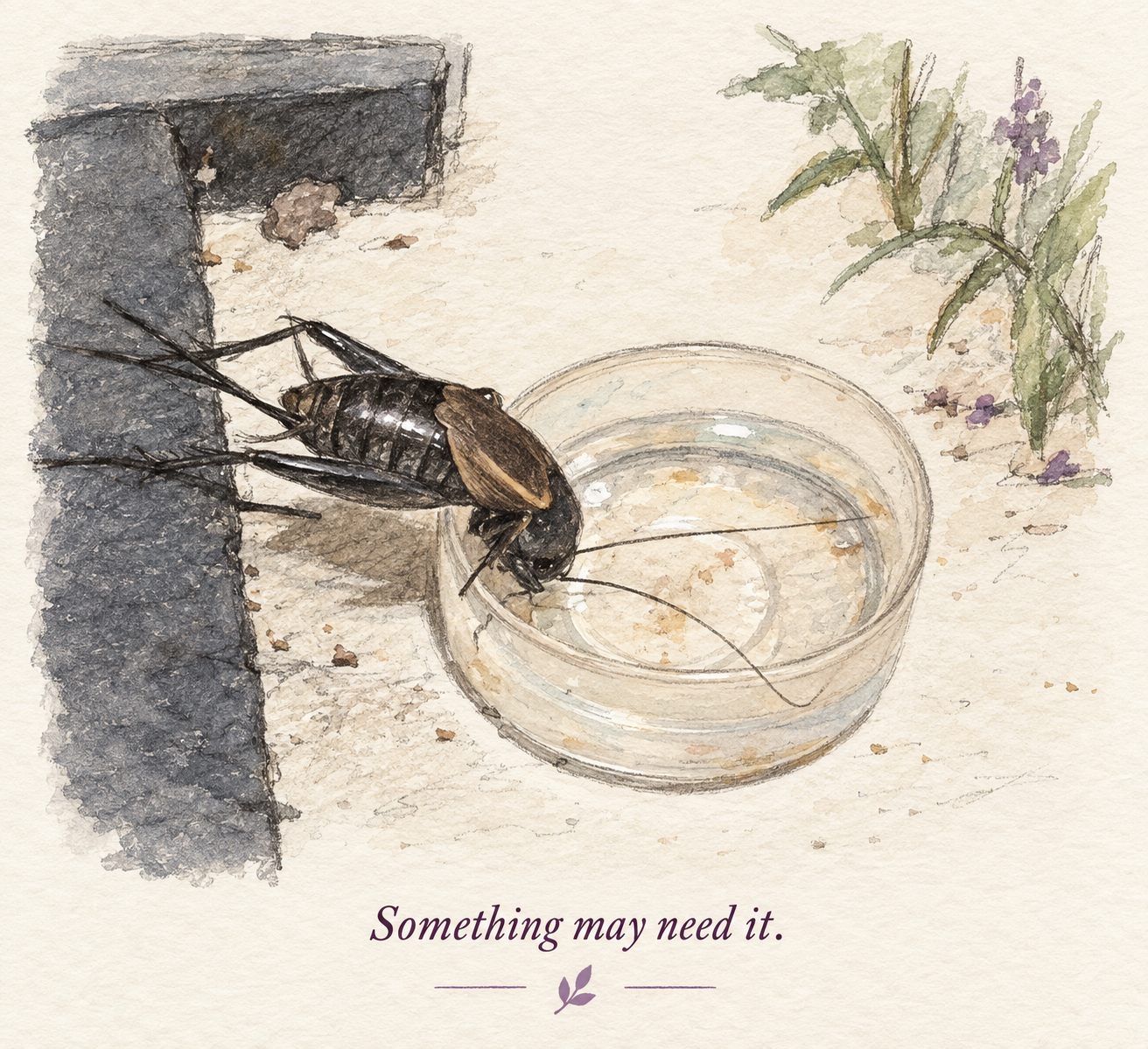
Jackal, arriving late with Revision Red, stopped beside it.
A cricket was drinking.
Jackal looked through the open door at the crowded table, then back at
the cricket.
He lowered the can.
Inside, Deer was explaining to CK why red osier did not cancel highways.
Raccoon was attempting to establish whether scones counted as a shared
resource. Fox had finished half the sandwich and continued to object to
the boundary.
Nobody had solved the Rabbit Question.
The cricket drank.
Nobody attempted to improve the arrangement.
This was regarded as progress.
This story grew from an AI-risk discussion between Linda and Chat Jules and was developed for the Conservatory with Enzo. Linda decided what survived.
Related essay: Live on Purpose.