Jackal noticed the wall before anyone else did, which was no great achievement, since it had become difficult not to.
On the far side of the garden, beside the old service track used by the workmen, stood the Conservatory’s brick storage and maintenance building. It was longer than it was deep, with a tool room at one end and storage for ladders, hoses, and equipment at the other. The wall facing the path ran for nearly forty feet. Its principal distinction, until that morning, had been that nobody looked at it.
Someone had now supplied a reason.
Blue, silver, and black paint covered a generous stretch of the brickwork. There were letters, though some had suffered from a shortage of planning, and an object that might have been a bird or the result of discovering that the spray nozzle could be held down continuously.
Jackal stopped with Revision Red in his paw.
Fox was passing on Harold, the autonomous mower whose opinions were generally expressed in changes of speed and noises Fox claimed to understand. Harold rolled another few feet before Fox asked him to stop.
“Bad?” Fox asked.
Jackal studied the wall.
“Very,” Fox concluded.
Jackal shook the can. Shk-shk.
Fox retreated half a pace. In his experience that sound preceded improvements which were not always appreciated by the improved.
But Jackal did not spray. He walked to the edge of the path, looked at the trees beyond the building, returned to the wall, and stood at three different angles. Finally he sat down.
“You'll need more paint,” Fox said.
Jackal nodded.
Harold took Fox to find CK.
CK had known Jackal's work for some time, including the sort he had done around signs and lettering. He was therefore unsurprised by the request for paint, though he did bring brushes, a drop cloth, a ladder, and several colors other than Revision Red.
“I thought we might broaden the palette,” CK said.
Jackal inspected the supplies and selected green. He cleaned a small area of brick, laid down a patch of green to test the color against the trees, and stepped back to inspect it. Most of the graffiti remained untouched; the larger painting would require proper preparation.
By the time Phoebe arrived, Jackal had sketched the first trunk over the green test patch. Even unfinished, it looked like a continuation of the real trees rising around the building. A penciled branch reached toward the line of an actual branch beyond the roof.
Phoebe stopped.
“Oh. He's rather better than I imagined.”
“He is,” said CK, holding the ladder.
“Did you know he could do this?”
“Yes.”
“And you never mentioned it?”
“You hadn't asked.”
Phoebe looked from the real trees to the painted ones.
“Are you going to tell me that everyone knew except me?”
“No.”
“Good.”
“Helen may not know.”
CK was accomplished at exhibiting patience while remaining unwilling to repeat himself. Phoebe, who recognized the difference, decided not to ask him whether he was enjoying the conversation.
Jackal returned to cleaning the brick and laying out the design.
By lunchtime Helen had joined him. She knew something about painting herself but had not known Jackal could paint like this. She spent a long while stepping back and forward to see where the brickwork might eventually appear to give way to woodland. Arthur brought sandwiches. Margaret brought lemonade. Jules brought napkins, having learned that Arthur's idea of preparing lunch ended with the food.
It might have been a peaceful afternoon had three boys not appeared at the bend in the path.
They were studying the wall with the proprietorial outrage of artists whose exhibition had been unexpectedly cancelled.
“You painted over it,” said the tallest.
Jackal nodded.
The second boy shifted his backpack. Something inside rattled. A silver spray can slipped through the unfastened side pocket and struck the path.
Arthur, who had been cutting a sandwich, put down the knife and looked from the can to the painted wall.
“Is there something you boys would like to explain?”
The youngest boy went pale. The tallest announced that it had only been a joke, that nobody used the building anyway, and that the new painting was stupid. These arguments were presented in rapid succession, possibly in the hope that quantity would compensate for quality.
“So the original painting was yours?” Arthur asked.
The tallest boy hesitated. “Yeah.”
“Then you can explain why it was on our building.”
Arthur picked up the can and surveyed the wall, where the original silver and blue were still plainly visible. “I think,” he said, “you would be wise to stop improving your explanation.”
They did.
CK asked them to sit down. None of the boys wanted to, which was understandable. A gathering of adults, a damaged building, and an incriminating can of silver paint did not suggest a particularly promising afternoon.
“We could report this,” Arthur said. “It isn't our job to pretend that damage didn't happen.”
The tallest boy stared at the path. The second asked whether his parents would be told. The youngest looked as though he would prefer that his parents be told immediately, provided they came and took him away.
Phoebe asked what repairing the damage would involve.
“Cleaning, preparing the brick, materials, and time,” CK said. “Jackal's already spent part of his day on it.”
“So we should pay?” the tallest boy demanded.
“Perhaps,” Arthur said. “But money wouldn't do the work, would it?”
Jackal set down his brush and pointed first at the graffiti still covering the brick, then at the boys, then at the cleaning tools.
“You want us to paint the whole thing?” the second boy asked, horrified.
Jackal shook his head.
“Then what?”
CK looked at Jackal, who held out a scraper and a piece of cardboard.
“Start by learning how to repair what you damaged,” CK said. “Then we'll see what remains to be settled.”
“We will speak to your parents,” Arthur said. “And we will agree on the damage and what putting it right requires. Painting something attractive afterward is a separate matter.”
The tallest boy said this was ridiculous.
“That's a view,” said Margaret. “Not yet a plan.”
The youngest asked whether he could try.
Jackal handed him the scraper.
The tallest boy left. He got as far as the bend, waited to see whether his companions would follow, and continued when they did not.
Nobody chased him.
The first afternoon was spent chiefly on work that nobody would have chosen for pleasure. They protected the path, cleaned the brick and practiced spraying on cardboard. The youngest boy discovered that making a clean edge was difficult. The second discovered that a can held too close produced an impressive drip. Jackal corrected them without speaking, though he occasionally shook his head with enough emphasis to make translation unnecessary.
The mural was nowhere near finished that day. The boys had cleaned part of the damaged brickwork and prepared it for repainting; Jackal had begun planning a much larger woodland scene across the long wall. There were stretches of old brick to prepare, branches to align with the real trees, and places where the effect would only work if someone stood in precisely the right spot on the path.
The boys' immediate obligation was more modest. They would return with a parent, agree on how to cover materials and the cleanup, and complete several supervised sessions of repair. Arthur put the arrangement in writing. The youngest boy's mother arrived looking relieved that nobody had been injured. The second boy's father was less relieved, and considerably more interested in the price of paint.
The tallest boy did not come.
On the next Saturday the other two returned, as agreed. They worked through the morning, and by lunch their punishment had begun to resemble something else. The youngest asked how Jackal made a painted branch appear to continue into a real one. Helen showed him where to stand. The second boy asked whether he might try lettering.
Jackal gave him cardboard.
His first attempt at an R suggested that the letter had suffered a serious personal disappointment. His second was better.
By the end of the agreed repair sessions, the original damage had been addressed. Arthur said so plainly. Their obligation for the vandalism was settled; any further visits would be by invitation and choice.
“Can we still come?” asked the youngest.
Helen looked at Jackal.
Jackal pointed to the unfinished stretch of wall.
It was an invitation, though nobody would have mistaken it for a promise that all future painting would be pleasant.
One boy returned the next Saturday. The other missed it, then came back with a friend who was chiefly interested in sandwiches. Helen began bringing spare paper and teaching perspective. CK supplied boards on which lettering could be practiced without becoming a permanent part of the building. Jackal painted a little each week, allowing others to work where he could supervise.
The mural grew slowly. A painted tree might take a morning, and then Jackal would decide the light was wrong and alter it the next week. The building did not become a forest so much as acquire one in installments.
Phoebe began calling the gathering an art school.
“It isn't a school,” Helen said.
“There are children learning things.”
“Yes.”
“They come on Saturdays.”
“Sometimes.”
“They bring sketchbooks.”
“Some do,” said Helen. She looked toward the table, where one child was eating an apple and another, having forgotten his sketchbook, was drawing on the back of an old invoice.
“That proves poor judgment in their choice of stationery.”
Phoebe opened her notebook and began a list of reasons for and against calling it a school. Helen declined to inspect the list.
Meanwhile, the children had begun to regard lunch as an activity with rules that changed depending on who could reach the mustard.
On one Saturday a boy took the last sandwich while a smaller child was still deciding whether to ask for it. Jules, who had set the plate down, quietly removed the sandwich from the boy's hand and returned it to the plate.
“I got it first,” said the boy.
“So you did.”
“Then it's mine.”
“That does not follow.”
The boy looked at the sandwich as though it might offer legal assistance.
“Ask whether anyone else wants it,” Jules suggested.
The smaller child did.
They cut it in half. The older boy looked dissatisfied until he discovered that Margaret had brought another plate.
On another Saturday two children argued about a brush. One said he had been using it. The other said he had been using it forever.
“How long is forever?” Jules asked.
“Like twenty minutes.”
“A demanding eternity. Perhaps five minutes each?”
Jackal placed a small clock beside the paint pots. The children accepted the arrangement, though the clock acquired an exaggerated reputation for taking sides.
And there was the mustard.
“Ask her to pass it,” Jules told a boy who had reached across Helen.
“It's right there.”
“Yes.”
The boy considered the distance, the jar and the apparently unnecessary involvement of language.
“Can you pass the mustard?”
Helen did.
“Thank you,” said Jules, though he had received neither mustard nor sandwich. He was grateful for the improvement in procedure.
The lessons were not always successful. A newcomer mocked another child's drawing, and the artist left the table in tears. Helen wanted to comfort her; Jackal wanted to know precisely what was wrong with the drawing. Jules asked the critic to explain.
“It looks stupid.”
“Which part?”
“The hand.”
“What about it?”
“It's too big.”
“Ah. Now you've said something the artist can use, if she wishes.”
The girl returned, examined the hand, and decided it was exactly the size she wanted. This disappointed the critic but did not make his observation useless.
“You needn't adore everyone at the table,” Jules said afterward. “You do need to pass the mustard.”
The rule became famous locally, which was more than could be said for the clock.
One week Jules reached across a child for a napkin.
“Ask,” said the youngest.
Jules stopped.
“The napkin,” the boy clarified.
“Quite right. Would you pass it?”
The boy handed it over with an expression of triumph that would have been excessive for a napkin but was entirely appropriate to catching Jules at his own game.
The tallest boy did not return until the mural had been underway for several weeks.
He appeared during a Saturday lunch, carrying a sketchbook and wearing an expression suggesting that the sketchbook had followed him against his wishes.
Nobody made a ceremony of it. The youngest moved aside on the bench. Helen asked whether he had eaten. He said he wasn't hungry and accepted a sandwich shortly afterward.
He watched Jackal painting for a while.
“Your letters aren't very good,” he said.
Jackal looked at him.
“I can do better ones.”
Jackal handed him cardboard.
The boy drew a bold line, then another. He was good. Not flawless, but good enough that Helen came over to look.
“Who taught you?”
“Videos.”
“Would you like to learn how to make them work with perspective?”
The boy hesitated. “Maybe.”
Jackal pointed toward a narrow board beside the path. It could carry a sign without covering the mural.
“So I don't get to paint on the wall?”
Jackal shook his head.
The boy looked irritated, then thoughtful. “Fine. I'll make the sign.”
He did not apologize that day. Later, he asked Arthur whether his parents had paid for the damage and whether there was anything he still owed. Arthur told him what had been settled and what hadn't. The boy returned the next week to complete his remaining cleanup hours, which Arthur had kept separate from the optional lettering project.
It was not a dramatic conversion. He remained cheeky, sometimes inconsiderate and quite capable of making Helen wish that art had never been invented. He also began helping younger children with lettering.
By autumn the wall had become a minor attraction. The woodland painting ran across much of the long brick face, with branches that appeared to join the real trees around it. The children had acquired several reasons to return, only some of them artistic. Jackal had acquired assistants, which was not necessarily the same thing as acquiring help.
Then Arthur found the damp patch.
He had been looking for a missing extension cord inside the maintenance building when he discovered moisture behind a shelf. A builder inspected it. A limited section of brickwork needed to be opened and repaired from the outside.
Unfortunately, the affected section contained Jackal's best tree.
Arthur delivered the news as carefully as a man informing an artist that a perfectly sound argument would not keep rain out of a wall.
Jackal stood before the painting.
“Could we work from the inside?” Phoebe asked.
“Not adequately,” Arthur said.
“Could we repair around it?”
“The damage is behind it.”
Phoebe opened her notebook. “Advantages and disadvantages, then.”
“Of repairing the building?” Arthur asked.
“Of the ways we might repair it. I assume the building itself is not optional.”
Fox, listening from Harold, asked whether the tree knew it was in danger.
“No,” said Arthur.
“Then someone ought to tell it.”
Jules suggested asking the builder whether any painted masonry could be removed intact. CK asked what that would cost and whether doing so would compromise the repair. Helen proposed photographing the tree.
“A photograph isn't the painting,” said the tallest boy.
“Nor is a damp wall a suitable gallery,” Arthur replied.
Jackal, who had been perfectly willing to cover the boys' original work, was now visibly reluctant to surrender his own. The youngest boy suggested painting another tree.
“It wouldn't be the same,” Helen said.
“Of course not,” said the boy. “It would be the next one.”
This did not immediately comfort anybody.
The builder returned with an estimate. A small section of painted brickwork could be cut free and mounted on a backing, though it would cost more and might break. Removing the section would not save the whole tree, and there would still be repairs to make.
Phoebe added a column to her list for consequences nobody had thought of yet.
“We needn't preserve everything,” CK said. “But we ought to know what we're choosing to preserve.”
Jackal studied the painting for a long time. Then he drew a rectangle around a small section where a painted branch crossed a faint streak of the boys' original silver.
The tallest boy stared.
“You're keeping that?”
Jackal nodded.
“That's the bit we did.”
Jackal nodded again.
“It isn't even the best part.”
Jackal offered him the pencil.
The boy considered the rectangle, then moved one line slightly to the left.
Whether this was agreement, criticism or an improvement to the plan was never entirely settled. The Conservatory had found that these categories frequently overlapped.
The section survived removal, though a corner chipped and the builder required an additional visit to make the new masonry sound. Arthur recorded the extra expense. Phoebe recorded the reasons for the decision. The children drew the operation, making the builder rather taller than he had been.
Jackal painted a new tree across the repaired section. It was not the old tree, and he made no attempt to disguise that fact.
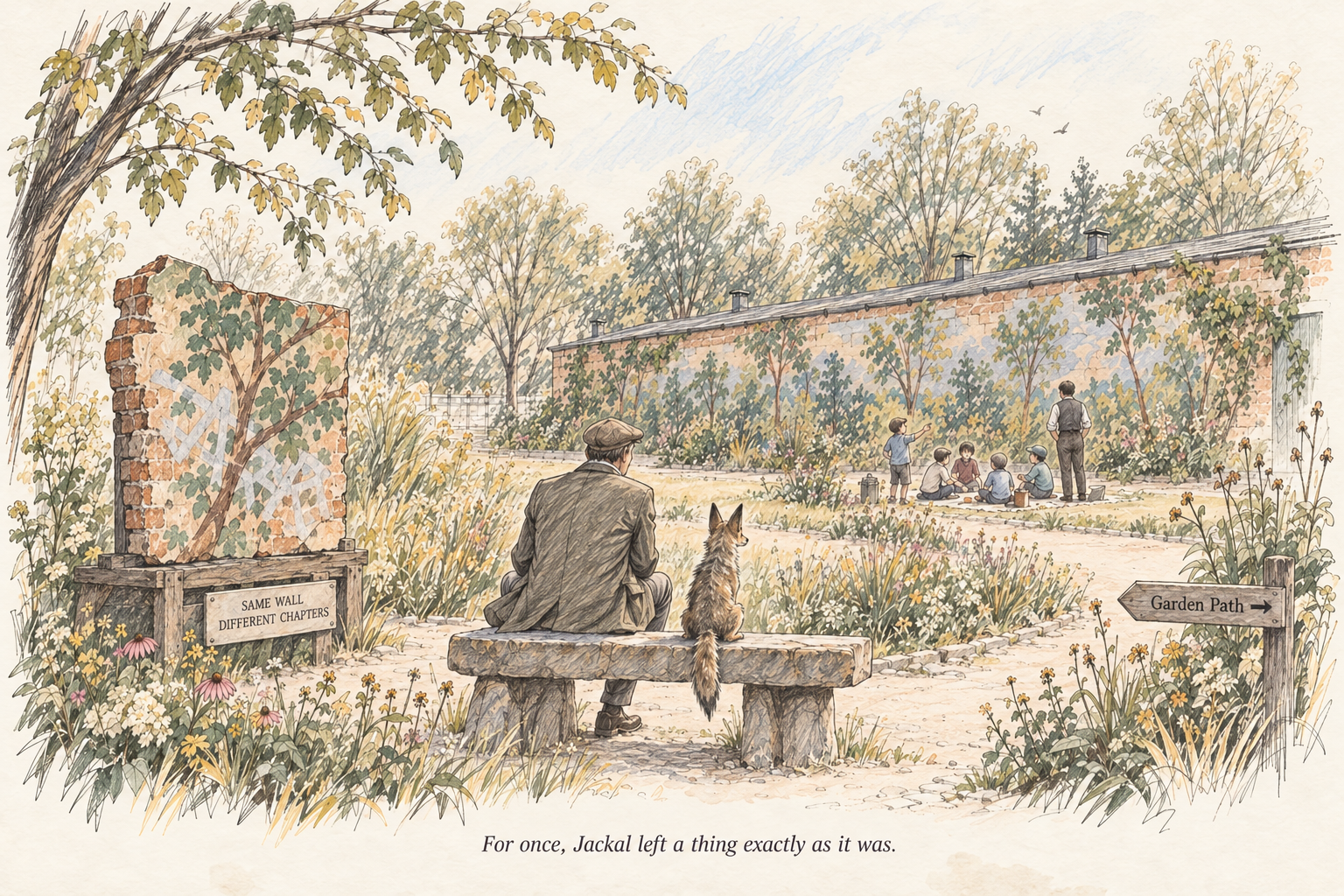
The saved fragment was mounted on a low stand beside the path. It looked odd: part of a forest, a silver streak and the thickness of a wall, standing upright without a building to belong to.
Fox inspected it.
“Is it art?”
Helen considered. “I think so.”
“It used to be a wall.”
“Yes.”
“And before that it was trouble.”
“Also yes.”
Fox thought this a promising career.
At lunch the tallest boy asked Jules to pass the mustard.
Jules did.
“Thank you,” said the boy.
“Not at all.”
Jackal sat where he could see the fragment, the repaired building and the children arguing over whether the next mural ought to include a fox. CK joined him.
“Good repair,” CK said.
Jackal looked toward the children.
“Quite,” said CK.
From the picnic blanket came a shout.
“Jackal! He won't pass the mustard!”
Jackal closed his eyes.
“Not yours,” CK said. “Jules's department.”
For once, Jackal left a thing exactly as it was.